
No posts were made by AI.

Showing posts with label Tech. Show all posts

Will Quantum Computers Replace PCs?

 700+ Free Quantum & Physics Images - Pixabay

Quantum computers are often described as the future of computing. News headlines regularly claim they will revolutionize medicine, crack impossible mathematical problems, and outperform today's fastest supercomputers. Some people even imagine a future where everyone owns a quantum laptop instead of the computers we use today.

It sounds exciting, but it also raises an important question.

Will quantum computers eventually replace the PCs sitting on our desks?

The answer is far more interesting than a simple yes or no.

To understand why, it helps to look at how today's computers actually work.

Every computer, from a smartwatch to the world's largest supercomputer, processes information using bits. A bit can have one of two values: 0 or 1. Everything your computer does, whether it's opening a web browser, rendering a video game, or editing a document, is built from billions of these tiny binary decisions happening every second.

Modern processors contain billions of transistors that rapidly switch between these two states. Their speed is astonishing, with some processors performing trillions of operations every second.

Quantum computers approach computation in a completely different way.

Instead of bits, they use quantum bits, better known as qubits. A qubit follows the laws of quantum mechanics, allowing it to exist in combinations of multiple states until it is measured. This unusual behavior gives quantum computers mathematical possibilities that traditional computers simply do not have.

Another important property is entanglement.

When qubits become entangled, the state of one qubit becomes linked to another, even though they remain separate physical objects. This allows quantum algorithms to coordinate information in ways that have no equivalent in classical computing.

These properties make quantum computers extremely powerful for certain kinds of calculations.

Researchers are developing quantum algorithms capable of solving mathematical problems that would take classical computers thousands or even millions of years. They could help simulate complex molecules, improve chemical research, optimize transportation networks, and discover new materials for batteries or medicines.

Despite these impressive possibilities, quantum computers are not universally faster.

The majority of everyday computing tasks simply do not benefit from quantum mechanics.

Writing documents, browsing the internet, watching videos, editing photos, playing games, or running an operating system all rely on calculations that classical computers already perform extremely efficiently. A quantum computer offers little advantage for these kinds of workloads.

In some cases, it would actually be slower.

Quantum computers are specialized machines designed for specialized problems. Running ordinary software on them would be like using a Formula One race car to deliver groceries. The machine is incredibly powerful within its intended purpose, but it is poorly suited for routine tasks.

Building a quantum computer also presents enormous engineering challenges.

Modern quantum processors operate under extremely unusual conditions. Many require temperatures only a fraction of a degree above absolute zero, colder than naturally occurring space. Large refrigeration systems surround the processor to keep thermal energy from disturbing the fragile quantum states.

Even tiny vibrations, electrical interference, or stray heat can introduce errors.

Because of this, today's quantum computers contain sophisticated systems dedicated to correcting mistakes. Many physical qubits are needed simply to create one reliable logical qubit capable of performing useful calculations.

This means that practical quantum computers capable of solving large real-world problems will likely require millions of physical qubits.

Current systems are still far from that goal.

Researchers continue making rapid progress, but the technology remains in its early stages. Every year brings improvements in stability, error correction, and manufacturing, yet significant engineering challenges remain before large-scale quantum computers become common.

Even if those challenges are solved, quantum computers are unlikely to replace classical computers.

The future is more likely to resemble the relationship between CPUs and GPUs today.

A CPU handles general-purpose computing. A GPU specializes in graphics and highly parallel calculations. Modern computers often use both, allowing each processor to perform the tasks it handles best.

Quantum processors will probably become another specialized component.

Scientists, engineers, pharmaceutical companies, financial institutions, and research laboratories may send particularly difficult calculations to quantum computers while continuing to use ordinary computers for everything else.

This model already exists in cloud computing.

Most people do not own supercomputers, yet they benefit from them every day through online services. Quantum computing may follow the same path. Instead of purchasing a quantum PC, users could access quantum hardware remotely whenever a problem requires it.

Another important reason classical computers will remain essential comes from measurement.

Quantum calculations eventually produce ordinary binary information that people can read and use. Displaying a website, storing a file, running an operating system, or controlling hardware still requires conventional electronics.

Quantum computers complement classical computers rather than replacing them.

History shows that new technologies rarely eliminate older ones completely.

Calculators did not replace pencils.

Digital cameras did not eliminate professional film photography overnight.

Smartphones did not make desktop computers disappear.

Instead, new technologies usually find the areas where they provide the greatest advantage while existing technologies continue evolving alongside them.

Classical computers are also improving.

Engineers continue developing faster processors, more efficient architectures, better memory technologies, and specialized AI hardware. Although transistor scaling has slowed, computing innovation continues through smarter designs instead of simply making components smaller.

For most people, the laptop sitting on a desk twenty years from now may still look surprisingly familiar.

Inside, however, the computing world could be very different.

A scientist developing a new medicine might send molecular simulations to a quantum computer. A logistics company could optimize thousands of delivery routes using quantum algorithms. Engineers might design advanced materials with the help of quantum calculations.

Meanwhile, someone writing an email, editing photos, watching videos, or playing games would still rely on a classical processor.

How Does a Search Engine Find a Website in Less Than a Second?

 Download Search Engine, Seo, Search. Royalty-Free Stock Illustration Image - Pixabay

Every day, billions of people type questions into a search engine. Sometimes it's something simple like "weather today." Other times it's an obscure programming error, the name of a song they forgot, or a scientific question that only a handful of websites discuss.

No matter what the search is, results usually appear in less than a second.

That speed is so common that most of us never stop to think about it. Searching the entire internet sounds like an impossible task. There are hundreds of millions of active websites and billions of individual web pages. If a search engine had to search the web from scratch every time someone pressed Enter, finding an answer would probably take hours instead of milliseconds.

The secret is that a search engine never searches the internet when you submit a query.

Instead, it searches an enormous index that has already been built long before you typed your question.

You can think of this index as the world's largest library catalog. Imagine walking into a library containing billions of books. Without an organized catalog, finding a single sentence inside one book would be nearly impossible. Libraries solve this problem by creating detailed records that describe where every book is located.

A search engine works in much the same way, except instead of books, it catalogs web pages.

The process begins with software known as web crawlers, often called spiders or bots. These automated programs constantly travel across the internet, visiting websites and following links from one page to another. Every time they discover new content, they collect information about it.

The crawler reads the page, identifies its text, images, headings, links, and many other details. All of this information is sent back to massive data centers, where another system analyzes and stores it.

This creates the search index.

The index is not a copy of the entire internet. Instead, it is a gigantic database describing what exists on billions of web pages. Words, phrases, topics, links, languages, publication dates, and hundreds of other pieces of information become part of this system.

By the time you perform a search, the engine has already spent days, weeks, or even months discovering and organizing that information.

That preparation is what makes searches so fast.

When you type a question, the engine does not begin exploring the web. It simply looks through its index to find pages that match your query.

Finding matching pages is only the first step.

If every page containing your search terms appeared in random order, the results would be almost useless. A search for "Python" could show programming tutorials, information about snakes, or pages that only mention the word once.

The engine therefore has another important job: deciding which pages deserve to appear first.

To do this, it evaluates hundreds of different ranking signals.

Some signals focus on relevance. A page dedicated to your topic is generally more useful than one that only mentions it briefly.

Other signals measure authority. When many trustworthy websites link to a page, that often suggests the content is valuable and reliable.

Freshness also matters. If someone searches for breaking news, recent information is usually more useful than an article published years ago. Historical topics, on the other hand, often benefit from older, well-established sources.

The overall experience of a website is also considered. Pages that load quickly, work well on mobile devices, and are easy to navigate tend to provide a better experience for visitors.

Modern search engines go far beyond matching individual words.

Early search systems depended heavily on exact keywords. If your search did not closely match the wording on a webpage, finding useful results became much more difficult.

Today's search technology is much better at understanding meaning.

For example, searching for "best laptop for university" and "good computer for college" will often produce very similar results because the engine recognizes that both searches are asking essentially the same question.

Artificial intelligence has become an important part of this process.

Machine learning systems help search engines recognize spelling mistakes, understand synonyms, identify related concepts, and estimate what a person is actually trying to find. Instead of treating every word separately, the system analyzes the entire query and the relationships between its words.

This becomes especially useful for longer questions.

Someone might search, "Why does my computer become slow after installing more programs?" The engine attempts to understand the overall meaning instead of searching for every individual word in the exact same order.

All of this happens incredibly quickly.

The moment you press Enter, your request travels across the internet to one of many data centers. These facilities contain hundreds of thousands of servers working together. They are distributed across different regions of the world so users can connect to one nearby, reducing the time needed for data to travel.

Inside the data center, specialized systems search the index, rank possible matches, generate summaries for each page, and return the results to your browser.

The entire process often finishes in only a few hundred milliseconds. 

That speed is the result of decades of engineering.

Search technology has continuously improved the way information is collected, compressed, stored, distributed, and processed. Even saving a few milliseconds becomes important when billions of searches happen every single day.

The work never stops, either.

New websites appear every day. Existing pages are updated constantly. Articles are edited, products change, companies launch new services, and major news stories spread across the internet within minutes.

Web crawlers continuously revisit websites, discover new pages, and refresh the search index so future searches reflect the latest available information.

No search engine is perfect.

The internet contains an enormous amount of spam, misleading information, duplicate pages, and outdated content. Ranking algorithms are constantly refined to improve search quality and reduce manipulation, making search technology one of the most actively developed areas of modern computing.

Despite these challenges, the modern search engine remains one of humanity's greatest engineering achievements.

Billions of web pages, millions of searches every hour, and answers delivered almost instantly. Behind a simple search box is an enormous system of crawlers, databases, machine learning models, networking infrastructure, and data centers working together around the clock.

How Do You Recognize Ai-Generated Posts?

 Download Ai, Artificial Intelligence, Sci-Fi. Royalty-Free Stock  Illustration Image - Pixabay

Artificial intelligence has become remarkably good at writing. A few years ago, AI-generated text was easy to spot because it often contained awkward grammar, repetitive phrases, and sentences that simply did not make sense. Today, the situation is very different. Modern AI can produce articles, emails, stories, and even computer code that often look as if they were written by a person.

As these systems improve, one question becomes increasingly important: can you still tell when a piece of writing was created by AI?

The short answer is yes, but not with complete certainty.

Many people believe there is a simple trick that instantly reveals AI-generated content In reality, there is no single sentence, phrase, or writing style that proves a text came from artificial intelligence. Human writers can sound robotic, and AI can be instructed to write naturally. The difference usually comes from patterns rather than individual clues.

One of the most noticeable characteristics of AI writing is consistency.

Humans naturally vary their writing. They change sentence length, switch between simple and complex vocabulary, tell small stories, make jokes, and occasionally break grammatical rules without thinking about it. Their writing reflects mood, personality, and experience.

AI tends to produce a smoother rhythm. Paragraphs often have a similar length, transitions feel carefully balanced, and the overall structure is highly organized. The article flows logically from one section to another, sometimes so smoothly that it feels almost too polished.

Another clue is the way information is presented.

AI usually explains ideas by covering the obvious points first before gradually becoming more detailed. Human writers often take unexpected paths. They might begin with a personal experience, jump to an interesting fact, return to the main topic, and end with a conclusion that connects everything together.

This unpredictability gives human writing a unique personality.

Details can also reveal a lot.

A person who has spent years building computers might describe the sound of an old hard drive spinning up, the frustration of troubleshooting a faulty graphics card, or the excitement of upgrading a system for the first time. Those small observations often come from lived experience.

Artificial intelligence does not have memories. It builds responses by recognizing patterns learned from enormous amounts of text. As a result, it usually describes experiences from a general perspective instead of recalling specific moments.

Another common sign is repetition.

AI sometimes revisits the same idea using different wording. An article might explain a concept, then explain it again with slightly different phrasing a few paragraphs later. Human writers certainly repeat themselves too, but experienced writers usually remove unnecessary repetition during editing.

Generalization is another pattern worth noticing.

An AI system often prefers statements that are broadly true. This reduces the chance of making factual errors, but it can also make the writing feel less distinctive. Human authors are more likely to include unusual examples, controversial opinions, or observations based on their own interests.

That does not mean AI cannot produce unique writing. Given enough instructions, it can imitate many different styles. The challenge is that it usually starts from the safest and most common version of a topic.

Confidence can also be misleading.

AI often presents information with a calm and authoritative tone, even when discussing subjects where there is uncertainty or ongoing scientific debate. Good human writers usually acknowledge uncertainty when it exists, explaining what researchers know, what remains unclear, and why experts continue to investigate the topic.

One area where AI has improved dramatically is grammar.

People often assume perfect grammar means a machine wrote the text. In reality, many professional writers produce extremely polished work after editing. At the same time, AI can intentionally include contractions, informal language, or even small mistakes if instructed to do so.

Grammar alone reveals very little.

Some readers also rely on AI detection tools. These websites analyze writing patterns and estimate whether a text was likely generated by artificial intelligence. Although they can sometimes identify common AI characteristics, they are far from perfect.

Researchers have repeatedly shown that these detectors produce false positives and false negatives. Human-written articles have been incorrectly labeled as AI-generated, while AI-generated articles have passed as completely human. Even students have occasionally been accused of using AI simply because their writing style appeared too formal.

Because of this, AI detectors should be treated as estimates rather than proof.

The rapid improvement of language models makes the problem even more difficult. Every new generation produces more natural writing than the last. Instructions can also change the style dramatically, allowing AI to imitate technical blogs, casual conversations, academic papers, or creative storytelling.

As the technology improves, the gap between human and AI writing continues to shrink.

Ironically, some of the strongest signs of human writing are imperfections. Small inconsistencies, unexpected comparisons, unfinished thoughts, and personal observations often make an article feel genuine because they reflect the way people naturally communicate.

Readers rarely notice these details consciously, but they contribute to the feeling that someone is speaking from experience rather than assembling information.

Perhaps the most important thing to remember is that good writing and AI writing are no longer opposites.

Many authors use AI to brainstorm ideas, improve grammar, or organize drafts before rewriting everything in their own voice. Others write entirely without assistance. The final article may include contributions from both a person and a machine, making strict labels increasingly difficult.

Transistors Are Getting So Small Quantum Mechanics Are Slowing Them Down

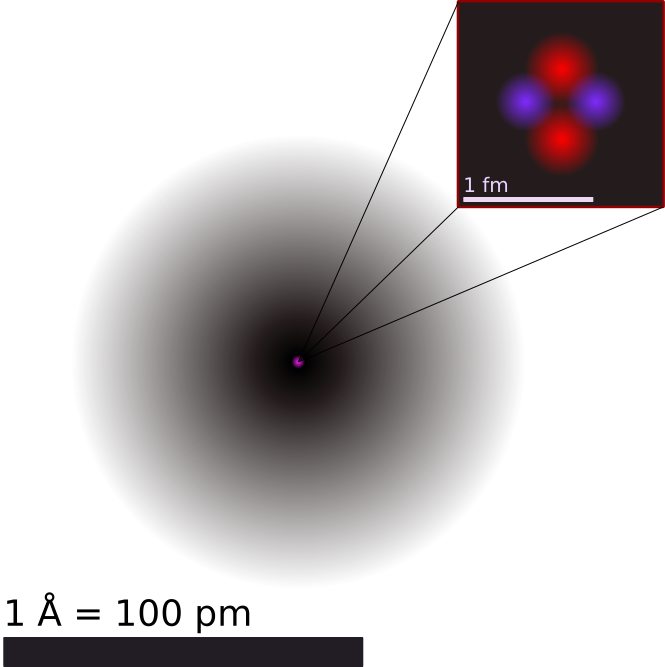
 Atom - Wikipedia

Every modern computer, smartphone, game console, and artificial intelligence system depends on a tiny piece of technology that most people never see: the transistor.

Transistors are the foundation of modern electronics. They act as extremely small switches that control the flow of electrical signals. Billions of these switches working together inside a single chip allow computers to perform calculations, store information, run applications, and process enormous amounts of data.

For decades, the computer industry followed a simple pattern. Engineers found ways to make transistors smaller, allowing more of them to fit onto a chip. More transistors meant more computing power, and this steady improvement became known as Moore's Law.

This trend transformed the world. A computer that once filled an entire room can now fit inside a smartphone. Modern processors contain billions of transistors, each smaller than a microscopic particle. The progress has been extraordinary.

However, engineers are approaching a point where making transistors smaller becomes increasingly difficult. At these extreme scales, the rules of everyday physics begin to change. The tiny components inside computer chips are reaching dimensions where quantum mechanics starts affecting how they behave.

Quantum mechanics is the branch of physics that describes the behavior of matter and energy at extremely small scales. At the level of atoms and particles, objects do not behave like the larger objects humans interact with every day. Particles can exist in unusual states, energy becomes quantized, and events that seem impossible in normal life become possible.

This creates a major challenge for semiconductor technology.

A transistor works by controlling the movement of electrons. In simple terms, it acts like a gate that can allow electricity to flow or block it. A computer uses billions of these gates switching between different states to represent the ones and zeros of digital information.

As transistors shrink, the physical barriers designed to control electrons become incredibly thin. Eventually, those barriers become so small that electrons can behave according to quantum rules.

One of the biggest problems is a phenomenon called quantum tunneling.

In everyday life, a person cannot walk through a wall because the wall creates a physical barrier. At the quantum level, particles such as electrons can sometimes pass through barriers that they normally should not be able to cross.

When transistor components become extremely small, electrons can leak through these barriers. Instead of staying where engineers expect them to stay, they can appear on the other side.

This leakage creates problems. It wastes energy, generates heat, and makes it harder for a transistor to reliably represent the difference between an "on" state and an "off" state.

For a single transistor, this effect may seem insignificant. Modern chips, however, contain billions of transistors. Small amounts of leakage multiplied across billions of components can become a serious engineering challenge.

Another problem comes from heat.

Smaller transistors allow more processing power in a smaller area, but increasing transistor density also creates enormous challenges for managing energy. Every time a transistor switches states, a small amount of energy is used and released as heat.

As more transistors are packed into a chip, removing that heat becomes increasingly difficult.

This is why modern processor design has changed. Instead of simply increasing clock speeds forever, engineers now focus on improving efficiency, adding more cores, creating specialized processors, and designing smarter architectures.

The industry has already adapted in many ways.

Modern CPUs use techniques such as three-dimensional transistor designs. For many years, traditional planar transistors placed components flat on the surface of a chip. Newer designs, such as FinFET and gate-all-around transistors, surround the electrical channel more effectively, giving engineers better control over electron movement.

Chip manufacturers are also exploring new materials and manufacturing techniques. Silicon has powered the computing revolution for decades, but researchers are investigating alternatives such as graphene, carbon nanotubes, and other advanced materials that could potentially allow smaller and more efficient electronics.

However, replacing silicon is extremely difficult. The entire global semiconductor industry is built around silicon manufacturing, with billions of dollars invested in factories, equipment, and research.

The challenge is not only creating a smaller transistor. Engineers must create millions or billions of identical transistors, manufacture them reliably, and produce them at a cost that makes sense.

At the smallest scales, even tiny imperfections can affect performance.

Modern chip factories are among the most advanced manufacturing facilities ever created. They use extremely precise machines to create patterns smaller than wavelengths of visible light. The process requires clean environments where even microscopic particles can damage a chip.

The complexity of these factories shows how difficult it has become to continue traditional transistor scaling.

This does not mean computing progress is ending.

The future of computing will likely involve many different approaches working together. Engineers are developing specialized AI accelerators, quantum computers, neuromorphic chips inspired by the brain, and new forms of computing that go beyond traditional CPU designs.

Software will also play a larger role. Better algorithms and more efficient programming can allow existing hardware to accomplish tasks with fewer resources.

The history of computing has always been shaped by overcoming limitations. Vacuum tubes were replaced by transistors. Transistors became smaller and more efficient. Single-core processors evolved into multi-core systems. New challenges have repeatedly pushed engineers toward new ideas.

Quantum mechanics is now becoming one of the major factors shaping the future of computer hardware.

The strange rules that govern the smallest particles are influencing the machines that control the modern world. The same physics that describes atoms and electrons is now determining how far humanity can continue shrinking technology.

For decades, engineers have been building smaller and smaller machines by controlling matter at increasingly tiny scales. They have reached a point where the behavior of individual particles matters.

The next generation of computers will come from understanding these limits and finding new ways around them.

The era of simply making transistors smaller is becoming more complicated, but the story of computing has never been about size alone.

How Can Minecraft Be Bigger Than The Observable Universe?

 100+ Free Minecraft & Video Game Images - Pixabay

Minecraft is one of the most successful video games ever created, but behind its simple appearance is a surprisingly deep piece of computer science. A world made of blocks, generated landscapes, and endless exploration hides a question that sounds almost impossible: how can a game world be larger than the observable universe?

The observable universe is the largest structure humanity has ever studied. It contains every galaxy, star, planet, and object whose light has had enough time to reach Earth since the beginning of the cosmos. Scientists estimate that it stretches across about 93 billion light-years, containing hundreds of billions of galaxies and an almost unimaginable number of stars.

A single light-year represents around 9.46 trillion kilometers, the distance light travels in one year. Even traveling at the fastest speed allowed by physics, crossing the observable universe would require an amount of time far beyond any human scale. The universe is so large that numbers used to describe it become almost meaningless to our everyday intuition.

Then there is Minecraft.

A Minecraft world can extend for millions of blocks in every direction. In the Java Edition of the game, the playable area reaches around 30 million blocks from the center before reaching the world border. Since each block represents roughly one meter, a single Minecraft map already contains an enormous amount of space.

The real reason Minecraft becomes comparable to something as large as the universe comes from the number of possible worlds the game can create.

Minecraft uses a technology called procedural generation. Instead of storing every mountain, cave, river, forest, and ocean inside the game files, it uses mathematical algorithms that generate environments automatically. The game follows a set of rules and creates terrain based on those instructions.

When a player creates a new Minecraft world, the game starts with a seed. This seed acts as the foundation for world generation, controlling how landscapes and structures are arranged. Different seeds produce completely different worlds, with different terrain, locations, and environments.

The number of possible Minecraft seeds is already enormous. Depending on the version and how the values are counted, there are around 18 quintillion possible seeds. That number is larger than the estimated number of stars in the observable universe.

However, the seed only determines the starting conditions. Each generated world contains countless possible arrangements of blocks, structures, caves, villages, and player creations. Every block placed or removed changes the state of the world, creating an enormous number of possible configurations.

This is where computing creates something fascinating. A computer can represent an enormous amount of complexity using a relatively small set of instructions.

A simple mathematical equation can generate a pattern containing millions of details. A short piece of code can create entire landscapes, ecosystems, or simulations. The information required to describe a system can be much smaller than the number of possible outcomes produced by that system.

Minecraft works through this principle.

The game stores the rules that create the world rather than storing every possible version of the world itself. When a player walks into an unexplored area, the computer calculates what should exist there and generates the terrain in real time.

This approach is used throughout computer science. Scientists create simulations of galaxies and weather systems using mathematical models. Engineers generate complex designs using algorithms. Game developers create massive environments without manually building every individual object.

Procedural generation allows small amounts of information to produce enormous complexity.

The concept reveals something important about the relationship between storage and possibility. A file containing a few kilobytes of information can describe a system capable of producing millions of different outcomes. The instructions themselves can be simple while the results become incredibly complex.

Minecraft takes advantage of this idea to create a world that feels almost infinite.

The game running on a computer contains only a small fraction of the information represented by the entire possible Minecraft universe. Most of the world exists as potential, waiting to be generated when the player reaches a new location.

This is similar to how many simulations work. They do not calculate every possible event in advance. They use rules that determine what happens when conditions change. The system creates information when it becomes necessary.

The difference between Minecraft and the physical universe comes from the way they exist. The universe contains matter, energy, and physical space. Minecraft contains data, algorithms, and virtual environments processed by electronic hardware.

A block of stone inside Minecraft is information stored in memory. The computer remembers a location and assigns it a value that represents stone. When the player interacts with it, the game updates that information and displays the result.

The illusion of a massive world comes from the relationship between computation and information.

This same idea appears in many areas of technology. Streaming services do not store every possible video frame on your device. They send information that allows the video to be reconstructed. Compression algorithms represent large amounts of data using smaller descriptions. Artificial intelligence systems learn patterns from enormous datasets and use those patterns to generate new information.

Modern computing is built around creating more from less.

Minecraft is a simple example of a much larger concept: complex systems can emerge from basic rules. A small collection of mathematical processes can create environments with millions of unique possibilities.

Nature follows a similar principle. The universe operates through a relatively small number of fundamental laws, yet those laws produce galaxies, stars, planets, chemistry, and life. Complexity emerges from interactions between simple foundations.

Minecraft demonstrates how powerful this idea can become inside a computer.

A few algorithms can generate landscapes larger than any human could explore. A small amount of data can represent an enormous number of possible worlds. A simple set of rules can create experiences that feel limitless.

When people say Minecraft can be bigger than the observable universe, they are describing the scale of possibilities contained within its system. The comparison comes from information, complexity, and potential arrangements rather than physical distance.

The universe is vast because it contains unimaginable amounts of matter and space. Minecraft is vast because a computer can use mathematics to create an enormous range of possibilities from a small collection of instructions.

Your Phone Addiction and Reward Systems: How They Manipulate Your Mind

Smart Phone, Mobile Phone 

The minute you open your phone, a silent battle begins for your attention. You might think you are just scrolling through a feed out of boredom, but behind the screen sits an incredibly complex network of algorithms designed to do one specific thing: keep you hooked. To achieve this, technology companies have essentially hacked human psychology by weaponizing our brain's natural reward system.

At the center of this digital trap is a powerful chemical called dopamine. In the natural world, dopamine is the brain's way of rewarding us for doing things that keep us alive or help us learn, like eating a good meal or achieving a goal. It creates a feeling of satisfaction that makes us want to repeat the behavior. Algorithms capitalize on this exact mechanism by turning social media into a virtual slot machine.

When you refresh a feed or pull down to see new videos, you are engaging in what psychologists call a variable reward schedule. If you knew exactly what you were going to get every time you opened an app, you would eventually get bored and put your phone down. Instead, the algorithm mixes things up. One swipe might bring a boring advertisement, the next might be a mildly funny meme, and the third might be a viral video that completely captivates you. Because the reward is unpredictable, your brain releases anticipation-driven dopamine before you even see the content. You keep scrolling because the next big hit of entertainment could be just one flick of your thumb away.

This constant craving fundamentally alters how we experience reality. Human attention spans have noticeably shrunk as algorithms condition us to expect immediate gratification. When your brain gets used to receiving a blast of novel, highly curated stimulation every few seconds, the physical world begins to feel painfully slow. Reading a book, sitting through a lecture, or just waiting in line becomes an exercise in extreme impatience.

Beyond making us restless, these algorithmic reward systems deeply impact our self-esteem and social anxiety. Features like likes, views, shares, and follower counts act as quantifiable metrics of social validation. Every notification is a tiny digital pat on the back that triggers another micro-dose of dopamine. The danger arises when the algorithm decides to throttle your reach or change what content it pushes forward. Suddenly, the steady stream of validation dries up, and the human brain, which is wired to seek peer approval for survival, interprets this algorithmic shift as personal rejection. This can trigger intense feelings of inadequacy, loneliness, and anxiety.

The ultimate goal of these platforms is to maximize watch time, and algorithms quickly figured out that negative emotions like outrage, fear, and tribalism keep people online much longer than positive emotions. By feeding us content that triggers anger or validates our deepest insecurities, the algorithm creates a feedback loop of emotional distress. We become stuck in a cycle of outrage scrolling, where our distress is literally monetized by tech companies.

- Michael