Every modern computer, smartphone, game console, and artificial intelligence system depends on a tiny piece of technology that most people never see: the transistor.
Transistors are the foundation of modern electronics. They act as extremely small switches that control the flow of electrical signals. Billions of these switches working together inside a single chip allow computers to perform calculations, store information, run applications, and process enormous amounts of data.
For decades, the computer industry followed a simple pattern. Engineers found ways to make transistors smaller, allowing more of them to fit onto a chip. More transistors meant more computing power, and this steady improvement became known as Moore's Law.
This trend transformed the world. A computer that once filled an entire room can now fit inside a smartphone. Modern processors contain billions of transistors, each smaller than a microscopic particle. The progress has been extraordinary.
However, engineers are approaching a point where making transistors smaller becomes increasingly difficult. At these extreme scales, the rules of everyday physics begin to change. The tiny components inside computer chips are reaching dimensions where quantum mechanics starts affecting how they behave.
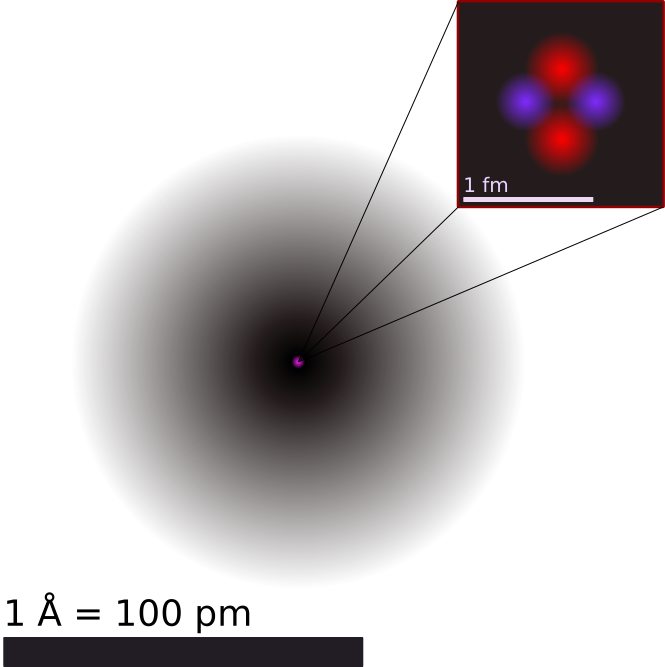
Quantum mechanics is the branch of physics that describes the behavior of matter and energy at extremely small scales. At the level of atoms and particles, objects do not behave like the larger objects humans interact with every day. Particles can exist in unusual states, energy becomes quantized, and events that seem impossible in normal life become possible.
This creates a major challenge for semiconductor technology.
A transistor works by controlling the movement of electrons. In simple terms, it acts like a gate that can allow electricity to flow or block it. A computer uses billions of these gates switching between different states to represent the ones and zeros of digital information.
As transistors shrink, the physical barriers designed to control electrons become incredibly thin. Eventually, those barriers become so small that electrons can behave according to quantum rules.
One of the biggest problems is a phenomenon called quantum tunneling.
In everyday life, a person cannot walk through a wall because the wall creates a physical barrier. At the quantum level, particles such as electrons can sometimes pass through barriers that they normally should not be able to cross.
When transistor components become extremely small, electrons can leak through these barriers. Instead of staying where engineers expect them to stay, they can appear on the other side.
This leakage creates problems. It wastes energy, generates heat, and makes it harder for a transistor to reliably represent the difference between an "on" state and an "off" state.
For a single transistor, this effect may seem insignificant. Modern chips, however, contain billions of transistors. Small amounts of leakage multiplied across billions of components can become a serious engineering challenge.
Another problem comes from heat.
Smaller transistors allow more processing power in a smaller area, but increasing transistor density also creates enormous challenges for managing energy. Every time a transistor switches states, a small amount of energy is used and released as heat.
As more transistors are packed into a chip, removing that heat becomes increasingly difficult.
This is why modern processor design has changed. Instead of simply increasing clock speeds forever, engineers now focus on improving efficiency, adding more cores, creating specialized processors, and designing smarter architectures.
The industry has already adapted in many ways.
Modern CPUs use techniques such as three-dimensional transistor designs. For many years, traditional planar transistors placed components flat on the surface of a chip. Newer designs, such as FinFET and gate-all-around transistors, surround the electrical channel more effectively, giving engineers better control over electron movement.
Chip manufacturers are also exploring new materials and manufacturing techniques. Silicon has powered the computing revolution for decades, but researchers are investigating alternatives such as graphene, carbon nanotubes, and other advanced materials that could potentially allow smaller and more efficient electronics.
However, replacing silicon is extremely difficult. The entire global semiconductor industry is built around silicon manufacturing, with billions of dollars invested in factories, equipment, and research.
The challenge is not only creating a smaller transistor. Engineers must create millions or billions of identical transistors, manufacture them reliably, and produce them at a cost that makes sense.
At the smallest scales, even tiny imperfections can affect performance.
Modern chip factories are among the most advanced manufacturing facilities ever created. They use extremely precise machines to create patterns smaller than wavelengths of visible light. The process requires clean environments where even microscopic particles can damage a chip.
The complexity of these factories shows how difficult it has become to continue traditional transistor scaling.
This does not mean computing progress is ending.
The future of computing will likely involve many different approaches working together. Engineers are developing specialized AI accelerators, quantum computers, neuromorphic chips inspired by the brain, and new forms of computing that go beyond traditional CPU designs.
Software will also play a larger role. Better algorithms and more efficient programming can allow existing hardware to accomplish tasks with fewer resources.
The history of computing has always been shaped by overcoming limitations. Vacuum tubes were replaced by transistors. Transistors became smaller and more efficient. Single-core processors evolved into multi-core systems. New challenges have repeatedly pushed engineers toward new ideas.
Quantum mechanics is now becoming one of the major factors shaping the future of computer hardware.
The strange rules that govern the smallest particles are influencing the machines that control the modern world. The same physics that describes atoms and electrons is now determining how far humanity can continue shrinking technology.
For decades, engineers have been building smaller and smaller machines by controlling matter at increasingly tiny scales. They have reached a point where the behavior of individual particles matters.
The next generation of computers will come from understanding these limits and finding new ways around them.
The era of simply making transistors smaller is becoming more complicated, but the story of computing has never been about size alone.

0 Comments:
Post a Comment