
No posts were made by AI.

Showing posts with label Physics. Show all posts

Transistors Are Getting So Small Quantum Mechanics Are Slowing Them Down

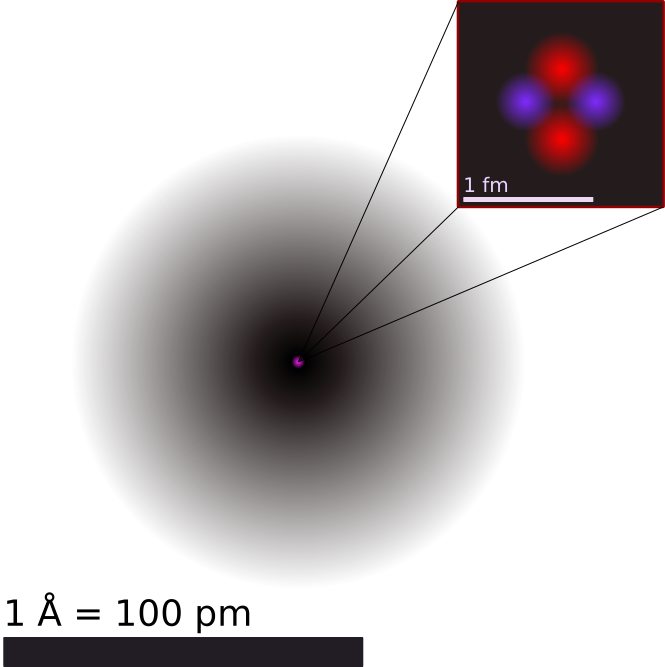
 Atom - Wikipedia

Every modern computer, smartphone, game console, and artificial intelligence system depends on a tiny piece of technology that most people never see: the transistor.

Transistors are the foundation of modern electronics. They act as extremely small switches that control the flow of electrical signals. Billions of these switches working together inside a single chip allow computers to perform calculations, store information, run applications, and process enormous amounts of data.

For decades, the computer industry followed a simple pattern. Engineers found ways to make transistors smaller, allowing more of them to fit onto a chip. More transistors meant more computing power, and this steady improvement became known as Moore's Law.

This trend transformed the world. A computer that once filled an entire room can now fit inside a smartphone. Modern processors contain billions of transistors, each smaller than a microscopic particle. The progress has been extraordinary.

However, engineers are approaching a point where making transistors smaller becomes increasingly difficult. At these extreme scales, the rules of everyday physics begin to change. The tiny components inside computer chips are reaching dimensions where quantum mechanics starts affecting how they behave.

Quantum mechanics is the branch of physics that describes the behavior of matter and energy at extremely small scales. At the level of atoms and particles, objects do not behave like the larger objects humans interact with every day. Particles can exist in unusual states, energy becomes quantized, and events that seem impossible in normal life become possible.

This creates a major challenge for semiconductor technology.

A transistor works by controlling the movement of electrons. In simple terms, it acts like a gate that can allow electricity to flow or block it. A computer uses billions of these gates switching between different states to represent the ones and zeros of digital information.

As transistors shrink, the physical barriers designed to control electrons become incredibly thin. Eventually, those barriers become so small that electrons can behave according to quantum rules.

One of the biggest problems is a phenomenon called quantum tunneling.

In everyday life, a person cannot walk through a wall because the wall creates a physical barrier. At the quantum level, particles such as electrons can sometimes pass through barriers that they normally should not be able to cross.

When transistor components become extremely small, electrons can leak through these barriers. Instead of staying where engineers expect them to stay, they can appear on the other side.

This leakage creates problems. It wastes energy, generates heat, and makes it harder for a transistor to reliably represent the difference between an "on" state and an "off" state.

For a single transistor, this effect may seem insignificant. Modern chips, however, contain billions of transistors. Small amounts of leakage multiplied across billions of components can become a serious engineering challenge.

Another problem comes from heat.

Smaller transistors allow more processing power in a smaller area, but increasing transistor density also creates enormous challenges for managing energy. Every time a transistor switches states, a small amount of energy is used and released as heat.

As more transistors are packed into a chip, removing that heat becomes increasingly difficult.

This is why modern processor design has changed. Instead of simply increasing clock speeds forever, engineers now focus on improving efficiency, adding more cores, creating specialized processors, and designing smarter architectures.

The industry has already adapted in many ways.

Modern CPUs use techniques such as three-dimensional transistor designs. For many years, traditional planar transistors placed components flat on the surface of a chip. Newer designs, such as FinFET and gate-all-around transistors, surround the electrical channel more effectively, giving engineers better control over electron movement.

Chip manufacturers are also exploring new materials and manufacturing techniques. Silicon has powered the computing revolution for decades, but researchers are investigating alternatives such as graphene, carbon nanotubes, and other advanced materials that could potentially allow smaller and more efficient electronics.

However, replacing silicon is extremely difficult. The entire global semiconductor industry is built around silicon manufacturing, with billions of dollars invested in factories, equipment, and research.

The challenge is not only creating a smaller transistor. Engineers must create millions or billions of identical transistors, manufacture them reliably, and produce them at a cost that makes sense.

At the smallest scales, even tiny imperfections can affect performance.

Modern chip factories are among the most advanced manufacturing facilities ever created. They use extremely precise machines to create patterns smaller than wavelengths of visible light. The process requires clean environments where even microscopic particles can damage a chip.

The complexity of these factories shows how difficult it has become to continue traditional transistor scaling.

This does not mean computing progress is ending.

The future of computing will likely involve many different approaches working together. Engineers are developing specialized AI accelerators, quantum computers, neuromorphic chips inspired by the brain, and new forms of computing that go beyond traditional CPU designs.

Software will also play a larger role. Better algorithms and more efficient programming can allow existing hardware to accomplish tasks with fewer resources.

The history of computing has always been shaped by overcoming limitations. Vacuum tubes were replaced by transistors. Transistors became smaller and more efficient. Single-core processors evolved into multi-core systems. New challenges have repeatedly pushed engineers toward new ideas.

Quantum mechanics is now becoming one of the major factors shaping the future of computer hardware.

The strange rules that govern the smallest particles are influencing the machines that control the modern world. The same physics that describes atoms and electrons is now determining how far humanity can continue shrinking technology.

For decades, engineers have been building smaller and smaller machines by controlling matter at increasingly tiny scales. They have reached a point where the behavior of individual particles matters.

The next generation of computers will come from understanding these limits and finding new ways around them.

The era of simply making transistors smaller is becoming more complicated, but the story of computing has never been about size alone.

How Can Minecraft Be Bigger Than The Observable Universe?

 100+ Free Minecraft & Video Game Images - Pixabay

Minecraft is one of the most successful video games ever created, but behind its simple appearance is a surprisingly deep piece of computer science. A world made of blocks, generated landscapes, and endless exploration hides a question that sounds almost impossible: how can a game world be larger than the observable universe?

The observable universe is the largest structure humanity has ever studied. It contains every galaxy, star, planet, and object whose light has had enough time to reach Earth since the beginning of the cosmos. Scientists estimate that it stretches across about 93 billion light-years, containing hundreds of billions of galaxies and an almost unimaginable number of stars.

A single light-year represents around 9.46 trillion kilometers, the distance light travels in one year. Even traveling at the fastest speed allowed by physics, crossing the observable universe would require an amount of time far beyond any human scale. The universe is so large that numbers used to describe it become almost meaningless to our everyday intuition.

Then there is Minecraft.

A Minecraft world can extend for millions of blocks in every direction. In the Java Edition of the game, the playable area reaches around 30 million blocks from the center before reaching the world border. Since each block represents roughly one meter, a single Minecraft map already contains an enormous amount of space.

The real reason Minecraft becomes comparable to something as large as the universe comes from the number of possible worlds the game can create.

Minecraft uses a technology called procedural generation. Instead of storing every mountain, cave, river, forest, and ocean inside the game files, it uses mathematical algorithms that generate environments automatically. The game follows a set of rules and creates terrain based on those instructions.

When a player creates a new Minecraft world, the game starts with a seed. This seed acts as the foundation for world generation, controlling how landscapes and structures are arranged. Different seeds produce completely different worlds, with different terrain, locations, and environments.

The number of possible Minecraft seeds is already enormous. Depending on the version and how the values are counted, there are around 18 quintillion possible seeds. That number is larger than the estimated number of stars in the observable universe.

However, the seed only determines the starting conditions. Each generated world contains countless possible arrangements of blocks, structures, caves, villages, and player creations. Every block placed or removed changes the state of the world, creating an enormous number of possible configurations.

This is where computing creates something fascinating. A computer can represent an enormous amount of complexity using a relatively small set of instructions.

A simple mathematical equation can generate a pattern containing millions of details. A short piece of code can create entire landscapes, ecosystems, or simulations. The information required to describe a system can be much smaller than the number of possible outcomes produced by that system.

Minecraft works through this principle.

The game stores the rules that create the world rather than storing every possible version of the world itself. When a player walks into an unexplored area, the computer calculates what should exist there and generates the terrain in real time.

This approach is used throughout computer science. Scientists create simulations of galaxies and weather systems using mathematical models. Engineers generate complex designs using algorithms. Game developers create massive environments without manually building every individual object.

Procedural generation allows small amounts of information to produce enormous complexity.

The concept reveals something important about the relationship between storage and possibility. A file containing a few kilobytes of information can describe a system capable of producing millions of different outcomes. The instructions themselves can be simple while the results become incredibly complex.

Minecraft takes advantage of this idea to create a world that feels almost infinite.

The game running on a computer contains only a small fraction of the information represented by the entire possible Minecraft universe. Most of the world exists as potential, waiting to be generated when the player reaches a new location.

This is similar to how many simulations work. They do not calculate every possible event in advance. They use rules that determine what happens when conditions change. The system creates information when it becomes necessary.

The difference between Minecraft and the physical universe comes from the way they exist. The universe contains matter, energy, and physical space. Minecraft contains data, algorithms, and virtual environments processed by electronic hardware.

A block of stone inside Minecraft is information stored in memory. The computer remembers a location and assigns it a value that represents stone. When the player interacts with it, the game updates that information and displays the result.

The illusion of a massive world comes from the relationship between computation and information.

This same idea appears in many areas of technology. Streaming services do not store every possible video frame on your device. They send information that allows the video to be reconstructed. Compression algorithms represent large amounts of data using smaller descriptions. Artificial intelligence systems learn patterns from enormous datasets and use those patterns to generate new information.

Modern computing is built around creating more from less.

Minecraft is a simple example of a much larger concept: complex systems can emerge from basic rules. A small collection of mathematical processes can create environments with millions of unique possibilities.

Nature follows a similar principle. The universe operates through a relatively small number of fundamental laws, yet those laws produce galaxies, stars, planets, chemistry, and life. Complexity emerges from interactions between simple foundations.

Minecraft demonstrates how powerful this idea can become inside a computer.

A few algorithms can generate landscapes larger than any human could explore. A small amount of data can represent an enormous number of possible worlds. A simple set of rules can create experiences that feel limitless.

When people say Minecraft can be bigger than the observable universe, they are describing the scale of possibilities contained within its system. The comparison comes from information, complexity, and potential arrangements rather than physical distance.

The universe is vast because it contains unimaginable amounts of matter and space. Minecraft is vast because a computer can use mathematics to create an enormous range of possibilities from a small collection of instructions.

Why Computing Will Take Centuries to Approach the Capability of the Brain

Discover the Best Brain Images and Pictures for Your Projects | Free HD Stock Photos - Pixabay 

The human brain is one of the most impressive systems known to exist. Inside a structure that weighs little more than a kilogram are billions of interconnected cells capable of producing thought, creativity, memory, imagination, and awareness. It allows humans to understand complex ideas, create technology, write music, explore space, and ask questions about the universe itself.

Meanwhile, modern computers have reached extraordinary levels of performance. A smartphone today contains more computing power than some of the computers that guided early space missions. Supercomputers can perform trillions of calculations every second. Artificial intelligence systems can analyze enormous amounts of information, generate text, recognize images, and solve problems that would have seemed impossible only a few decades ago.

Yet the human brain remains far ahead in many areas. A child can learn from a handful of examples, understand new situations, and adapt to unfamiliar environments with remarkable efficiency. Reproducing this level of flexibility and understanding remains one of the greatest challenges in computer science.

The reason comes from the fundamental differences between biological and electronic systems.

The brain contains around 86 billion neurons connected by hundreds of trillions of synapses. These connections form an incredibly complex network where information is stored and processed through patterns of electrical and chemical activity. Every experience, memory, and skill changes this network over time.

Computers are built around a different philosophy. Modern processors rely on billions of transistors arranged into carefully designed circuits. These components perform calculations by following instructions created by programmers and software systems. Their strength comes from speed, precision, and reliability.

The brain's strength comes from its ability to operate as a constantly changing network.

A modern processor might contain several powerful cores working at extremely high speeds. The brain works through massive parallelism, with billions of neurons communicating simultaneously. Every second, countless processes happen at the same time, from interpreting sensory information to controlling muscles and maintaining memories.

This architecture gives the brain an incredible level of efficiency.

The human brain consumes around 20 watts of power, roughly similar to a small light bulb. Some of the world's most advanced supercomputers require megawatts of electricity and entire facilities dedicated to cooling and maintaining them.

This difference in energy efficiency is one of the biggest engineering challenges in creating brain-like computers.

Biological neurons also have properties that current computer components do not fully replicate. A neuron is not simply an electrical switch. It can receive signals, process information, change its connections, and influence future activity based on previous experiences.

This ability allows the brain to learn continuously.

When someone learns a new language, practices a sport, or gains knowledge, the physical structure of the brain changes. Connections between neurons become stronger or weaker, creating new patterns that represent memories and abilities. This process is known as neuroplasticity.

Traditional computers store information differently. Data exists in memory locations, storage devices, and networks. Machine learning systems can adjust their internal parameters during training, but their learning process is still a simplified version of what happens inside biological brains.

Scientists are working on new approaches that move closer to the brain's design. Neuromorphic computing attempts to create hardware inspired by neurons and synapses. These systems use specialized chips designed to process information in ways that resemble biological networks.

Artificial intelligence has also made major progress through neural networks. Modern AI models contain billions of parameters and can perform impressive tasks. However, human intelligence remains difficult to reproduce because it involves much more than recognizing patterns. Humans build internal models of the world, combine knowledge across different areas, and apply experiences in completely new situations.

Understanding the brain itself remains one of the largest scientific challenges.

Researchers have mapped many aspects of neural activity, but the full process behind memory, imagination, reasoning, and consciousness is still being investigated. The brain is the result of millions of years of evolution, with countless biological processes working together.

Creating a machine with similar abilities requires understanding those processes at a much deeper level.

Computing hardware also faces physical limits. For decades, improvements followed Moore's Law, with transistor counts increasing dramatically every generation. Modern chips now contain billions of transistors packed into incredibly small spaces.

As components approach atomic scales, engineers face challenges involving heat, energy consumption, and quantum effects. Future progress will likely require new materials, new architectures, and completely different approaches to computation.

Technologies such as quantum computers, optical processors, biological computers, and advanced AI systems may eventually transform computing. Each represents a different attempt to overcome the limitations of traditional hardware.

However, matching the human brain requires more than increasing raw processing power. A computer with more calculations per second would still need the right architecture, learning mechanisms, and ability to interact with the world.

Human intelligence developed through constant interaction with reality. The brain learned through millions of years of evolution and individual experiences. Every memory, decision, and interaction contributes to the way humans think.

Future computers may eventually reach or surpass many aspects of human intelligence. Technology has repeatedly exceeded expectations, and today's machines would appear impossible to people living only a century ago.

The challenge is the scale of the problem.

The human brain represents an extraordinary combination of computation, adaptation, efficiency, and complexity. Building something comparable requires advances across neuroscience, computer science, physics, and engineering.

The computers of the future may look completely different from the machines we use today. They may combine artificial intelligence with new forms of hardware, perhaps creating systems that operate closer to biological brains.

Humanity has already created machines capable of calculations beyond anything our ancestors imagined.

The next challenge is creating machines that can understand, learn, and adapt with the same elegance as the most advanced computer ever discovered: the human brain.

Why is The Night Sky Dark if There Are an Infinite Number of Stars?

The Sun 

Have you ever looked at the night sky and wondered why it is dark? It seems like a simple question, but it leads to one of the most interesting problems in astronomy. When we look up, we see thousands of stars shining above us, and on a clear night away from city lights, we can even see the glowing band of the Milky Way. The universe appears full of light, yet most of the sky remains completely dark.

This creates a strange question. The universe contains hundreds of billions of galaxies, and each galaxy contains billions or even trillions of stars. If there are so many stars, and if space continues endlessly in every direction, why isn't the entire sky glowing like the surface of the Sun?

This problem became known as Olbers' Paradox, named after German astronomer Heinrich Wilhelm Olbers, who studied the question in the 1800s. However, scientists had already been thinking about this mystery long before him. The idea was simple: if the universe was infinite, eternal, and filled evenly with stars, darkness should not exist.

Imagine looking in any direction across an infinite universe. Eventually, your line of sight should hit the surface of a star. Nearby stars would appear bright because they are close, while distant stars would appear weaker because their light would have to travel much farther to reach you. However, there would also be far more distant stars than nearby ones.

The number of stars would continue increasing the deeper you looked. The extra stars should compensate for their weaker light, meaning every layer of space would contribute more brightness. If you added up all the light from an infinite number of stars, the entire sky should be shining.

But that is not what we see.

For a long time, scientists tried to find explanations for this contradiction. One idea was that huge amounts of dust between the stars were blocking the light from distant objects. At first, this seemed like a possible solution. Maybe the universe was actually full of light, but we simply could not see it because something was hiding it.

The problem is that dust cannot block light forever. If a cloud of dust absorbed enough energy from billions of stars, it would gradually heat up. Eventually, that dust would become hot enough to glow by itself, creating a bright sky again. The dust explanation could not solve the paradox.

The real answer came from one of the biggest discoveries in science: the universe has a beginning.

For a long time, many people imagined the universe as something eternal and unchanging. However, modern astronomy showed that the universe began approximately 13.8 billion years ago in an event known as the Big Bang. This completely changed how we understand the darkness of the night sky.

The reason is simple: light needs time to travel.

Even though light moves incredibly fast, traveling around 300,000 kilometers per second, it still takes time to cross the universe. Because the universe has only existed for a limited amount of time, light from extremely distant stars and galaxies has not had enough time to reach us.

There could be countless stars beyond what we can see, but their light has not arrived yet.

When we look into space, we are not seeing the entire universe. We are only seeing the part of the universe from which light has had enough time to reach Earth. This region is called the observable universe, and beyond its boundary there may be countless galaxies that are currently invisible to us.

However, the age of the universe is only part of the explanation. The universe is also expanding, and this expansion changes the light traveling through space.

As galaxies move away from each other, the space between them stretches. Light traveling through this expanding space gets stretched as well, increasing its wavelength. This effect is called redshift.

A star that once emitted visible light billions of years ago may now have its light stretched into infrared or microwave radiation. The light still exists, but our eyes cannot detect it. In a way, the universe is filled with light that is simply outside the range of human vision.

One of the best examples of this is the Cosmic Microwave Background, the oldest light we can observe. This radiation was released when the universe was only about 380,000 years old. At that time, the universe was much hotter and brighter than it is today.

Over billions of years, cosmic expansion stretched that ancient light until it became microwave radiation. If human eyes could see microwaves, the entire sky would have a faint glow coming from every direction.

The darkness of space does not mean there is no light. It means much of the light in the universe is either too far away, has not reached us yet, or has been transformed into wavelengths we cannot see.

There is another reason the night sky is not permanently bright: stars themselves are temporary.

Every star is powered by nuclear fusion, a process that converts lighter elements into heavier ones while releasing enormous amounts of energy. For millions or billions of years, stars shine across galaxies, creating the beautiful skies we see today.

But eventually, every star reaches the end of its life. Some slowly fade away into white dwarfs. Others explode as supernovae and leave behind neutron stars or black holes. Even the Sun, which has supported life on Earth for billions of years, will eventually run out of fuel.

The night sky we see today is only a snapshot of a much larger cosmic story. Billions of years ago, the universe was filled with more active stars because star formation happened at a much faster rate. In the distant future, the universe will become much darker as fewer new stars are created and existing stars continue to disappear.

The darkness in the night sky is what makes it so interesting. It teases us that something is there, waiting to be theorized and discovered. 

What is Entropy?

 Water - Wikipedia

Take a look around your room. If you stopped cleaning it for a month, would it somehow become neater on its own? Probably not. Clothes would pile up, dust would settle on every surface, and random objects would slowly spread across the floor. It takes effort to keep things organized, but almost no effort for them to become messy.

This simple observation is one of the best ways to understand entropy.

Entropy is one of the most important concepts in physics, yet it is also one of the most misunderstood. Many people describe it as "disorder," but that explanation is only partly true. A better way to think about entropy is that it measures how spread out energy is and how many different ways a system can exist. The higher the entropy, the more evenly energy is distributed and the less useful it becomes for doing work.

At first, that might sound abstract, but entropy affects nearly everything around us. It explains why ice melts, why hot coffee cools down, why engines cannot be perfectly efficient, and even why time seems to move in only one direction.

To understand entropy, imagine placing a drop of blue food coloring into a glass of water. At first, the dye remains concentrated in one small area. After a few minutes, it spreads throughout the entire glass until the water becomes evenly colored.

Have you ever seen the opposite happen?

You never watch blue water suddenly separate itself into perfectly clear water and a single drop of concentrated dye. Physics does not forbid that arrangement, but it is so unbelievably unlikely that it might as well never happen.

The reason is simple. There are vastly more ways for the dye molecules to be spread throughout the glass than there are for all of them to gather in one tiny spot. Nature almost always moves toward the state with the greatest number of possible arrangements.

That tendency is entropy in action.

The same idea explains why heat always flows from hot objects to cold ones. Imagine placing a hot cup of coffee on your desk. The coffee contains thermal energy that is concentrated in one place. As time passes, that energy spreads into the surrounding air, the mug, and eventually the entire room.

The room becomes very slightly warmer while the coffee becomes cooler.

What never happens is the reverse. Your cold coffee does not suddenly absorb heat from the room and become freshly brewed again without any outside energy. That would require countless air molecules to coordinate perfectly, which is statistically so improbable that it simply does not occur in everyday life.

This leads to one of the fundamental laws of physics, the Second Law of Thermodynamics. It states that in an isolated system, entropy tends to increase over time.

That does not mean everything immediately becomes chaotic. Instead, it means energy naturally spreads out and becomes more evenly distributed. Every process leaves the universe just a little more balanced than it was before.

Many people think entropy means that everything is constantly becoming more disorganized, but this is not always true.

Local order can absolutely increase.

A tree grows from a tiny seed into a highly organized living organism. Snowflakes form beautiful, symmetrical patterns. Human beings build cities, computers, and spacecraft.

These examples seem to contradict entropy, but they actually do not.

The key is that these systems are not isolated. A tree receives energy from sunlight. Humans consume food to fuel their bodies and machines. Earth constantly receives enormous amounts of energy from the Sun. While order increases locally, even more entropy is created elsewhere through waste heat and other energy transfers.

In other words, creating order always comes at a cost.

This idea becomes even more fascinating when we think about life itself.

Every living organism survives by taking in low entropy energy and releasing higher entropy waste. Plants capture sunlight and convert it into chemical energy. Animals eat food that stores this energy, use part of it to stay alive, and release the rest as heat.

Your own body follows this rule every second. The warmth you feel coming from your skin is evidence that your body is increasing the entropy of its surroundings while maintaining its own internal organization.

Without this continuous flow of energy, life would not be possible.

Entropy also has a surprising connection to the direction of time.

Most laws of physics work equally well whether time moves forward or backward. If you watched two planets orbiting a star in reverse, the motion would still obey gravity. A pendulum swinging backward would still follow the same equations.

But imagine watching a video of a shattered glass flying together, landing perfectly on a table, and becoming whole again.

You would immediately know the video was reversed.

The reason is entropy.

A whole glass has relatively low entropy compared to thousands of tiny pieces scattered across the floor. Breaking the glass increases the number of possible arrangements. Putting every fragment back into exactly the right position without outside intervention is extraordinarily unlikely.

This is why many physicists believe entropy is deeply connected to what is known as the arrow of time. We remember the past instead of the future because entropy has been increasing since the universe began.

The universe itself started in an incredibly low entropy state shortly after the Big Bang. That fact is one of the greatest mysteries in modern physics.

At first glance, the early universe looked chaotic. It was unimaginably hot and dense. However, despite those extreme conditions, matter was distributed remarkably evenly across space. This uniform beginning gave the universe enormous potential for complexity to develop over billions of years.

As gravity gathered matter into stars, galaxies, and planets, new structures formed while the overall entropy of the universe continued increasing.

Stars shine because nuclear fusion converts concentrated energy into heat and light. Every second, the Sun increases the entropy of the universe by radiating energy into space.

Eventually, even stars run out of fuel.

Billions or even trillions of years from now, the universe is expected to reach a state where most stars have burned out, galaxies have drifted far apart, and useful energy has become extremely scarce.

This future is known as the Heat Death of the universe.

Despite its name, Heat Death is actually an incredibly cold future. Energy will still exist, but it will be spread so evenly that almost no useful work can be performed anymore. Without energy differences, there can be no engines, no weather, no shining stars, and possibly no life.

It is the ultimate consequence of entropy increasing over unimaginable stretches of time.

Entropy also plays a major role in modern technology.

Car engines waste energy as heat because no engine can be one hundred percent efficient. Computers generate heat while processing information. Refrigerators remove heat from inside by releasing even more heat into the surrounding room. Every machine ever built obeys the same thermodynamic laws.

Even the most advanced technologies cannot escape entropy.

Scientists have also discovered fascinating connections between entropy and information. In information theory, entropy measures uncertainty or the amount of information contained in a message. This idea has become essential in fields like data compression, artificial intelligence, cryptography, and quantum computing.

Perhaps even more surprising is the fact that black holes appear to possess entropy. According to modern physics, a black hole's entropy is related to the area of its event horizon rather than its volume. This unexpected discovery has provided important clues in the search for a theory that unites gravity and quantum mechanics.

Although entropy often sounds pessimistic, it is simply a description of how nature behaves. Without entropy, stars would never shine, planets would never form, weather would never exist, and life itself would likely be impossible.

The same physical principle that ensures your coffee eventually becomes cold also allows the universe to evolve, create complexity, and support living organisms.

Entropy is not the enemy of order. Instead, it is the rule that governs how energy moves and transforms throughout the cosmos.

What will happen at the End of The Universe?


CIRCULAR MAP OF THE UNIVERSE ALL VERSIONS - Pablo Carlos Budassi

It is strange to think about the fact that the universe has an ending. We often look at the night sky and imagine the stars as permanent fixtures, shining exactly as they always have. In reality, the universe is constantly changing. Stars are born, galaxies collide, and space itself continues to expand every second. Nothing lasts forever, not even the cosmos.

Scientists have spent decades trying to understand what the distant future might look like. While nobody knows with complete certainty how the universe will end, modern observations have given us several fascinating possibilities. Some ideas are more likely than others, but they all remind us that the universe is a dynamic place with a history and, eventually, a future unlike anything we experience today.

The story begins nearly 13.8 billion years ago with the Big Bang. Contrary to what many people imagine, the Big Bang was not an explosion into empty space. It was the rapid expansion of space itself. Since then, galaxies have been moving farther apart as the universe grows larger. For a long time, scientists assumed gravity would eventually slow this expansion. Instead, one of the biggest discoveries in astronomy revealed the opposite.

In the late 1990s, astronomers found that the expansion of the universe is actually speeding up. Something mysterious, now called dark energy, appears to be pushing galaxies away from each other faster as time passes. Dark energy makes up about 68 percent of the total energy content of the universe, yet nobody fully understands what it is. Its existence has completely changed our predictions about the universe's future.

The most widely accepted scenario today is known as the Heat Death of the universe. Despite its dramatic name, it is not a fiery ending. It is actually a future where almost nothing happens anymore.

As galaxies continue moving apart, they become increasingly isolated. Billions of years from now, distant galaxies will have traveled so far away that their light will never reach us again. Future civilizations, if any still exist, may only be able to observe their own galaxy. They might never discover that billions of other galaxies once filled the universe.

Meanwhile, stars continue living their lives. Every star shines because nuclear fusion in its core releases enormous amounts of energy. Eventually, however, every star runs out of fuel. Small stars fade into white dwarfs, larger stars explode as supernovae, and the most massive ones collapse into neutron stars or black holes. Over incredibly long periods of time, fewer and fewer new stars are born because the gas needed to create them gradually becomes exhausted.

Eventually, the universe enters an era where almost no stars remain. The skies become darker than anything we can imagine today. Most galaxies transform into collections of dead stellar remnants drifting through nearly empty space.

Black holes become some of the last active objects in existence. For many years, scientists believed black holes would last forever. Then physicist Stephen Hawking introduced a revolutionary idea known as Hawking radiation. According to quantum mechanics, black holes slowly lose energy by emitting tiny amounts of radiation. The larger the black hole, the slower this process occurs.

A stellar black hole might take an unimaginable amount of time to disappear, but supermassive black holes at the centers of galaxies would survive far longer. Some calculations suggest they could exist for up to 10¹⁰⁰ years before completely evaporating. That number is so enormous that it makes the current age of the universe seem almost insignificant.

When the final black holes disappear, the universe enters what may be its quietest stage. Matter becomes extremely spread out, temperatures approach absolute zero, and almost no useful energy remains. This is the Heat Death. Nothing dramatic explodes. Nothing spectacular collapses. Instead, the universe slowly reaches maximum entropy, a state where energy is evenly distributed and no meaningful physical processes can continue.

While Heat Death is currently considered the most likely outcome, it is not the only possibility scientists have explored.

One alternative is called the Big Crunch. In this scenario, gravity eventually overcomes cosmic expansion. The universe stops expanding and begins shrinking. Galaxies move closer together, temperatures rise, and everything becomes increasingly dense. Eventually, all matter and energy collapse into an incredibly small state similar to the conditions that existed before the Big Bang.

For many years, the Big Crunch was considered a serious possibility. However, current observations indicate that expansion is accelerating rather than slowing, making this scenario much less likely based on everything astronomers know today.

Another fascinating possibility is known as the Big Rip. This idea depends on dark energy becoming stronger over time. If that happened, the expansion of space would accelerate to extreme levels. Galaxies would first separate completely. Later, gravity would no longer be strong enough to hold galaxies together. Then solar systems would break apart. Eventually, even planets, atoms, and the fundamental particles inside them could be torn apart by the expansion of space itself.

The Big Rip sounds like science fiction, but it comes directly from mathematical models of cosmology. Fortunately, current evidence does not strongly support this outcome, although scientists continue studying dark energy because its true nature remains one of physics' greatest mysteries.

There are also more speculative ideas that are difficult to test. Some physicists suggest that our universe exists in what is called a false vacuum. If true, space itself could someday transition into a lower energy state. Such an event would create a bubble expanding at the speed of light, changing the laws of physics wherever it passed. Everything inside that bubble would be fundamentally altered.

This possibility is known as vacuum decay. Although it sounds terrifying, there is no evidence that such a transition is about to occur. If it ever did happen, nobody would see it coming because the bubble would move at the speed of light. Thankfully, calculations suggest that if vacuum decay is possible at all, it is probably so unlikely that it may never happen during the lifetime of our universe.

One of the most remarkable aspects of studying the universe's end is the timescales involved. Human civilization has existed for only a few thousand years. Modern science has been around for just a few centuries. Even Earth itself is only about 4.5 billion years old. Yet many predictions about the universe extend trillions, quadrillions, or even numbers so large that ordinary language struggles to describe them.

Thinking about such immense periods changes our perspective. Problems that seem enormous in everyday life become tiny compared to cosmic history. At the same time, it reminds us how special the present era truly is. We live during a time when stars fill the sky, galaxies are visible across the universe, and life has emerged on at least one small planet orbiting an ordinary star.

Scientists will continue refining these predictions as new discoveries are made. Better measurements of dark energy, gravity, quantum mechanics, and the large scale structure of the universe may completely reshape our understanding of the distant future. History has shown that every generation of astronomers uncovers surprises that previous generations never imagined.

For now, the evidence points toward a universe that does not end with a dramatic explosion or a sudden collapse. Instead, it slowly grows colder, darker, and quieter over unimaginable stretches of time. Stars burn out, galaxies drift beyond view, black holes evaporate, and the cosmos gradually settles into eternal stillness.

Everything that has a start will eventually end. Even death will die. 

- Michael